
Electrochemical Test Cell with Gas Collection
PREDEST® S-EC-GC1A | YASA ET
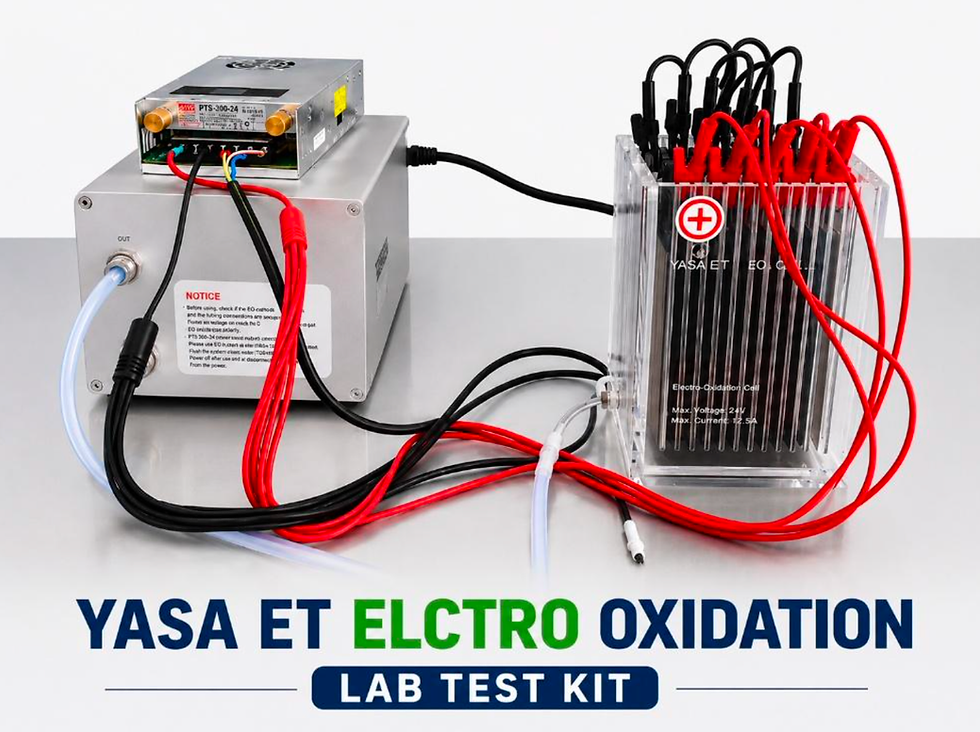
YASA ET introduces the S-EC-GC1A, a covered laboratory electrochemical test cell developed from its existing EC/EO test cell platform. A removable transparent lid and gas collection connection allow gas generated during an experiment to be directed to an external collection arrangement, while the transparent tank keeps the electrode assembly visible.

A covered cell for laboratory electrochemical studies
The cell combines an acrylic reactor, a flat plate electrode assembly, liquid inlet and outlet connections, and electrical terminals. The bolted lid provides a defined headspace above the liquid and a connection for routing evolved gas through tubing. This makes it possible to include gas collection in a laboratory treatment experiment alongside visual observation of the liquid and electrodes.
The accompanying kit is equipped with an adjustable 0–24 V DC, 0–30 A power supply and a circulation pump with a flow range of 40–100 L/h. The power supply accepts selectable 110/220 V AC input.
Technical specifications
Parameter | Specification |
Model | PREDEST® S-EC-GC1A |
Product type | Laboratory electrochemical test cell with gas collection connection |
Reactor material | Transparent acrylic |
Cover | Removable transparent lid secured by perimeter bolts |
Gas connection | Lid mounted gas outlet valve for external collection tubing |
Electrode configuration shown | 4 aluminium anode plates and 4 iron cathode plates |
DC output voltage | 0–24 V, adjustable |
DC output current | 0–30 A, adjustable |
Power supply AC input | 110/220 V, selectable |
Pump circulation flow | 40–100 L/h |
Cell body dimensions | 204 × 152 × 200 mm; |
Cell assembly weight | 4.95 kg |
Liquid connections | Side inlet and outlet connections |
The drawing dimensions describe the cell body; allow additional space for protruding valves, terminals, tubing and maintenance access.
The stated weight applies to the depicted cell assembly, not the complete kit or shipping package.
What the new lid adds
An open test vessel allows evolved gas to disperse above the liquid. The covered design provides a headspace and an outlet for directing gas to an external collector or sampling arrangement. The lid can be removed for access to the electrode plates and cleaning between experiments.
The collection outlet provides a connection point. Quantitative gas measurement requires suitable external collection or measuring equipment and a checked collection setup. A single common headspace does not provide separate collection of anode and cathode gases.

Model designation
S-EC-GC1A extends the existing S-EC laboratory naming convention with GC for Gas Collection and retains the 1A family identifier. The model name distinguishes this covered version from the conventional open test cell.
Applications in electrochemical research
The S-EC-GC1A is intended for laboratory screening, teaching and process development. Researchers can use the transparent reactor to observe bubble formation, electrode changes and floc development while investigating the effect of electrical settings and liquid circulation.
With the aluminium and iron electrode arrangement shown, the cell supports electrocoagulation studies on suitable water and wastewater samples. Comparative trials can examine changes in turbidity, solids formation and other selected water quality parameters. Removal performance depends on the sample and test conditions and should be established experimentally.
Electrooxidation studies require electrode materials appropriate to the target chemistry. The aluminium and iron plates shown are not equivalent to catalytic oxidation electrodes. Alternative electrodes should be specified with YASA ET for the intended experiment.
Adjustable power and liquid circulation
The 0–24 V, 0–30 A DC supply gives researchers an adjustable electrical operating range. The actual current drawn by the cell depends on solution conductivity, electrode spacing, electrode condition and applied voltage. Record the actual voltage and current during each experiment to make comparisons meaningful.
The 40–100 L/h pump flow is the liquid recirculation range, not a guaranteed wastewater treatment throughput. Recirculation allows the sample to pass repeatedly through the cell. Actual flow depends on the installed tubing, valve settings and hydraulic resistance.
Planning a gas collection experiment
Connect the gas outlet to a collection arrangement suited to the expected gas composition and keep the gas path unobstructed during operation. The covered acrylic cell should not be operated as a pressurized reactor. Use suitable ventilation and keep ignition sources away where flammable gas may be generated. Gas composition depends on the electrolyte and electrodes; the collected gas should not be assumed to be pure hydrogen or oxygen.
Confirm the selected 110/220 V input setting against the laboratory supply before energizing the power supply. Define the sample volume, electrode materials, test duration and target measurements before starting, and keep these conditions consistent when comparing trials.
Discuss your laboratory application with YASA ET
Send YASA ET your sample characteristics, research objective, preferred electrodes and gas collection requirements to discuss a suitable test configuration.



Comments