
Electrocoagulation (EC) & Electrooxidation (EO) for Wastewater Treatment
Updated: Jan 28
How YASA ET turns tough industrial effluent into reusable water—step by step
Why electrochemical treatment now?
Industrial wastewater is getting more complex while discharge limits are getting tighter. Electrochemical technologies—Electrocoagulation (EC) and Electrooxidation (EO)—solve the two hardest jobs in treatment:
EC: removes suspended solids, oil/grease, heavy metals, color, phosphates, and a good portion of COD by generating coagulants in-situ.
EO: destroys difficult dissolved organics (recalcitrant COD), pathogens, and traces that slip through other processes often the last mile to compliance or reuse.
Used alone or in sequence, EC and EO help plants cut chemical usage, reduce sludge volumes, and stabilize performance.
What is Electrocoagulation (EC)?
Electrocoagulation uses sacrificial metal electrodes (typically iron or aluminum) in a DC field. At the anode, metal ions are released and hydrolyze to form fresh coagulant, at the cathode, hydrogen micro-bubbles lift floc to the surface. The result is rapid destabilization and removal of emulsified oils, color, colloids, metals, and part of the dissolved organics.
Highlights
Coagulant is generated on demand less chemical trucking and dosing
Produces dense, easily dewatered sludge compared to conventional coagulation
Excellent front-end step for oily, colored, metal-laden, or highly variable wastewater
Typical follow-up: settler, DAF, or filtration for solid–liquid separation
What is Electrooxidation (EO)?
Electrooxidation uses inert (non-sacrificial) anodes such as BDD (Boron-Doped Diamond) or MMO to create powerful oxidants (•OH radicals, active chlorine if chloride is present, sometimes ozone) right at the anode surface. These species mineralize dissolved organic pollutants and disinfect water ideal for polishing after EC, membranes, or biological treatment.
Highlights
Breaks down recalcitrant COD and micro-pollutants; supports ZLD strategies
No added oxidant handling—oxidants are generated in-situ and quenched in-line
Powerful disinfection without separate chlorination systems
Best used as a finishing step for energy efficiency
EC vs EO at a glance
Electrocoagulation (EC) | Electrooxidation (EO) | |
Main action | In-situ coagulant + flotation | In-situ advanced oxidation |
Targets | SS/Turbidity, oil/grease, color, metals, phosphates, partial COD | Recalcitrant COD, color residues, pathogens, odor, trace organics |
By-products | Coagulated sludge (low–moderate volume) | Minimal sludge; oxidized by-products |
Opex drivers | Electrode consumption + low–mid DC power | Higher DC power; inert/BDD anodes |
Best use | Front-end pre-treatment / bulk removal | Polishing / last-mile compliance & reuse |
Typical follow-up | Settler/DAF + filtration | Filtration/AC as needed, reuse or discharge |
Rule of thumb: Use EC first to take out the “big, sticky, and shiny” stuff (solids, oils, metals, color). Use EO second to finish the COD and disinfect.
YASA ET Lab & Pilot Solutions
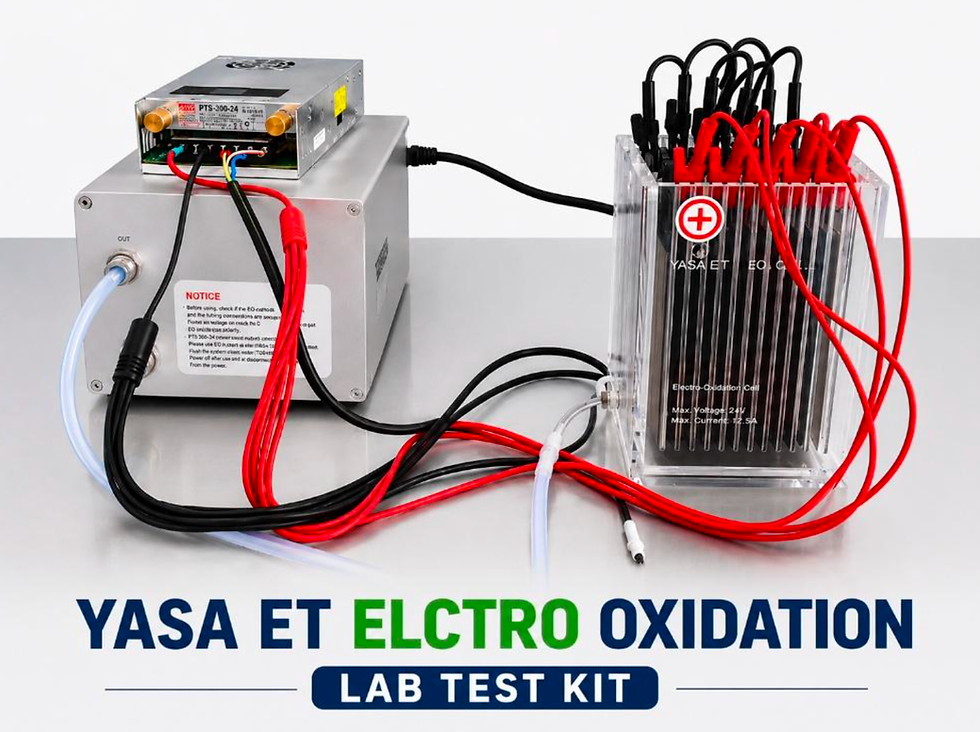
EC/EO Lab Test Kits (Acrylic reactors, ready to run)
Designed for universities, R&D teams, and industrial labs to find the right recipe before scaling up.
Model | Reactor Volume | Included EC Plates | Power Supply | Typical Use |
S-EC-1 | ~1 L | 4 × Al + 4 × Fe | 0–24 V / 0–30 A | Quick screening, jar-test replacement |
S-EC-5 | ~5 L | 5 × Al + 5 × Fe | 0–24 V / 0–30 A | Parameter optimization, repeatability |
S-EC-10 | ~10 L | 8 × Al + 8 × Fe | 0–24 V / 0–30 A | Scale-up trials, continuous‐flow simulation |
What’s in the kit: acrylic reactor (see-through), EC plates set, recirculation pump, tubing/valves, wiring, skid with flowmeter, and DC power. Add-on electrodes for EO: SS, Titanium, Ti/Ru-Ir MMO, BDD, Graphite, Magnesium, etc.
How-to videos
What’s included: https://youtu.be/azmangOIwt8
How to use (EC test): https://vimeo.com/995445001
EOXCell (EO add-on with BDD)
EOXCell is our electro-oxidation module that drops into the same test platform. It comes with BDD anodes and Titanium cathodes in compact, easy-to-plumb cells—ideal for COD polishing, color removal, and disinfection.
Video: How to test with EOXCell – https://vimeo.com/1028299790
How to run great EC/EO tests (and get scale-up-ready data)
1) Pre-check & preparation
Screening/filtration: remove >100 µm grit to protect hydraulics
pH: start near 6.5–7.5; adjust if data later shows a better window
Conductivity: for EO, keep sufficient conductivity (add small Na2SO4/NaCl if needed)
2) EC testing (typical plan)
Start with Fe and Al separately, then try mixed stacks (Fe/Al alternating)
Current density steps (example): 10 → 30 → 50 A/m²
Contact time ladder: 10–20–30 minutes (batch) or set equivalent HRT for flow-through
Capture: Turbidity/SS, oil & grease, color, COD, PO4-P, metals, pH, conductivity
Observe floc formation and froth; verify settle/float behavior
3) EO testing (polishing step)
Use BDD anode + Ti cathode; start with modest current density (e.g., 5–20 mA/cm²)
Track COD/TOC decay, color removal, ORP, and disinfection where relevant
If chloride is present, account for active chlorine formation (beneficial for disinfection; manage residuals appropriately)
4) Optimize & lock the recipe
Tune pH and current density for best removal per kWh
Validate retention time at the lowest power that meets targets
Record energy per m³ and electrode consumption (for EC) → inputs for scale-up
Electrode selection cheat-sheet
EC anodes (sacrificial):
Iron (Fe): strong for phosphate, many heavy metals, color; dense sludge that settles well
Aluminum (Al): excellent for emulsified oils, many dyes/organics; fluffy floc that floats well
Mix Fe/Al when both phosphate and emulsions matter
EO anodes (inert):
BDD: premium mineralization and disinfection; best overall polishing (higher capex)
MMO (Ti/Ru-Ir): robust and cost-effective for many EO duties
PbO₂/graphite: application-specific; consult for compatibility
Cathodes: Titanium or SS commonly used; keep surfaces clean to minimize over potential.
Operations & maintenance tips
Avoid passivation: use automatic polarity reversal (EC power supplies support configurable intervals).
Keep plates clean: periodic air scouring and gentle acid wash when needed.
Expectations (lab → plant): Fe/Al plates last months depending on load; inert EO anodes last years when operated within design limits.
Downstream solids handling: pair EC with DAF or a settler + filter press for simple, reliable separation.
From lab to plant: the YASA ET scale-up path
Lab recipe using S-EC kit (+ EOXCell if polishing is required)
Pilot at representative flows (e.g., PREDEST-100/200 pilot units, containerized options)
Full-scale PREDEST EC systems with optional EO polishing and DAF/filters downstream
Typical full-scale scope (example PREDEST lines): stainless/PP reactor, modular plate stacks, auto-reversing DC supply, PLC (Siemens), instrumentation (pH, EC, level, temperature), dosing/air systems, and plug-and-play skids for rapid installation.

Animation: PREDEST process – https://youtu.be/BmEGZwFXZRA
DAF animation: https://youtu.be/5UbiFlWXucY
Case examples
Case 1 — Palm Oil Mill Effluent (POME), trial scale
Challenge: high SS, oil & grease, color, and COD. Approach: EC first with Fe/Al optimization, followed by settling and multimedia filtration. Outcome: clear permeate suitable for reuse/discharge; low chemical footprint; simple operation.

Case 2 — Schaeffler industrial wastewater, pilot → scale
Challenge: machining effluent with oil, surfactants, high COD; tight discharge/reuse targets. Approach: PREDEST EC front-end for bulk removal, EO (BDD) polishing, plus downstream separation. Outcome: major reductions in COD and oil; >80% water recycling reported in pilot conditions; supports plant-wide ZLD roadmap.


Frequently asked questions (FAQ)
1) EC or EO first?
Start with EC to remove solids/oils/metals and partial COD; use EO after to finish COD, color, and disinfection.
2) Do I need chemicals?
Usually, no that’s the beauty of electrochemical treatment. You may adjust pH and, for EO, add a small supporting electrolyte if conductivity is very low.
3) What current density should I use?
Begin conservative and step up: EC often 10–50 A/m² (plate reactors). EO (BDD) frequently 5–20 mA/cm² for polishing optimize with your water.
4) How do I choose Fe vs Al for EC?
Try both. Fe shines with phosphate/metals; Al shines with emulsions/color. Mixed stacks frequently win.
5) How do I handle sludge?
After EC, send to DAF or settler + filter press. Sludge volumes are generally lower than chemical coagulation.
6) Can I disinfect with EO?
Yes, EO provides strong disinfection via radicals/active chlorine (if chloride is present).
7) How do I scale up?
Use our lab kits to lock the recipe, then pilot on a PREDEST skid, then full-scale. We keep current density and HRT consistent and scale electrode area and flow.



Comments