
How to Choose the Right Electrocoagulation (EC) Test for Wastewater Treatment
Updated: Jan 28
Content
1. Introduction: Why EC Testing Matters Before Scale-Up
Electrocoagulation (EC) is widely recognized as an effective technology for treating industrial wastewater. However, EC performance is highly dependent on wastewater composition, operating parameters, and electrode configuration.
One of the most common and costly mistakes in EC projects is skipping proper lab or pilot testing and directly designing or purchasing a full-scale system based on assumptions.
This article explains how to choose the right EC test before full-scale design, helping engineers, consultants, and plant owners reduce risk, optimize performance, and control costs.
This guide focuses on electrocoagulation testing for industrial wastewater treatment before full-scale implementation

2. Why Electrocoagulation Performance Is Not Universal
Unlike conventional chemical coagulation, EC does not have a “one-size-fits-all” formula.
EC performance depends on multiple factors, including:
Wastewater conductivity and pH
Type and concentration of pollutants
Electrode material (Fe, Al, Ti)
Current density and voltage
Hydraulic mixing and flow pattern
The same EC system may work extremely well for one wastewater stream and perform poorly for another. Only proper testing can reveal the true treatment potential.
For applications involving harsh wastewater conditions, titanium electrodes may offer performance and lifetime advantages.
👉 Read more: Understanding Titanium Electrodes :
3. Risks of Skipping EC Lab or Pilot Testing
Skipping EC testing often leads to:
Oversized or undersized equipment
Excessive power consumption
Poor pollutant removal efficiency
Unexpected sludge characteristics
High operational cost (OPEX)
Project redesign or system retrofitting
In many cases, the cost of a small EC test is far lower than the cost of correcting a failed full-scale system.
Electrocoagulation performance depends on multiple factors such as electrode material, current density, and hydraulic conditions, which are explained in detail in A Complete Guide to Electrocoagulation.
4. Types of EC Tests: Lab Test vs Pilot Test
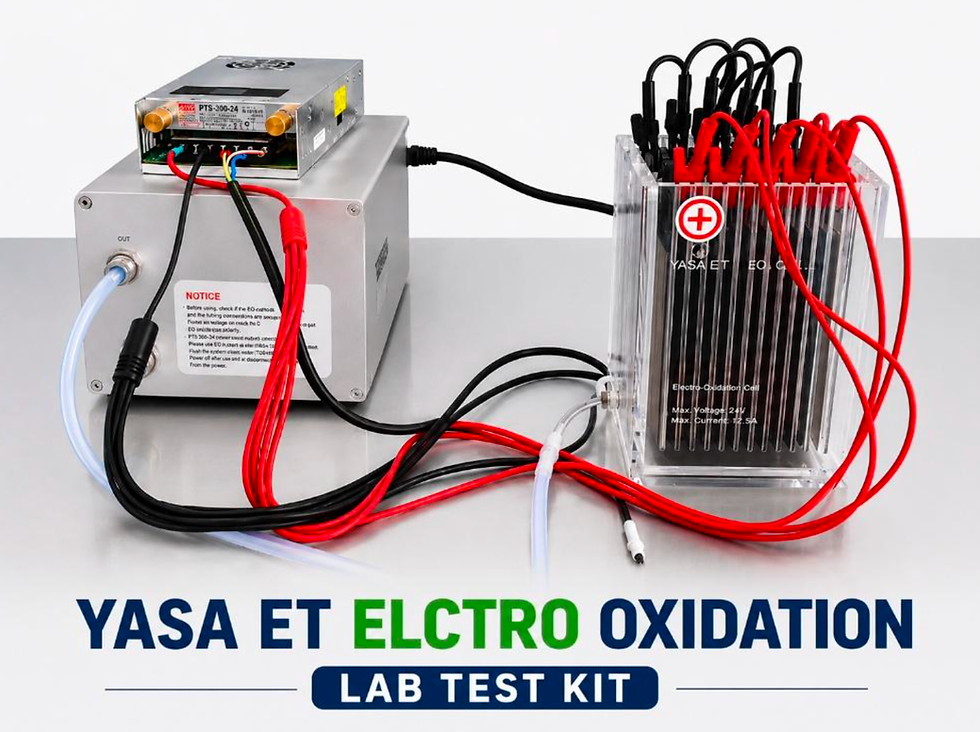
4.1 EC Laboratory Test
Purpose
Rapid feasibility assessment
Screening electrode materials
Initial parameter optimization
Typical scale
Batch or small recirculation system
Treatment volume: 1–20 L
Best for
Early-stage evaluation
R&D and academic studies
Comparing EC vs alternative technologies
4.2 EC Pilot Test
Purpose
Validate continuous operation
Confirm scale-up performance
Evaluate sludge handling and stability
Typical scale
Continuous flow system
Flow rate: tens to hundreds of L/h
Best for
Industrial project development
Consultant-led feasibility studies
Pre-ZLD or pre-RO treatment design
Our engineers can help you evaluate the right EC testing approach based on your water analysis and project stage.
5. Key Parameters Determined by EC Testing
An EC test helps determine critical design parameters, including:
Optimal current density
Required reaction time
Electrode material and spacing
Energy consumption (kWh/m³)
Sludge volume and dewaterability
Expected removal efficiency (COD, TSS, metals, color, oil)
These parameters are essential inputs for accurate full-scale EC system design.
6. How to Choose the Right EC Test for Your Project
Use the following guideline:
Project Stage | Recommended EC Test |
Early feasibility | Lab EC test |
Technology comparison | Lab EC test |
Process design | Pilot EC test |
EPC / investment decision | Pilot EC test |
ZLD or RO pretreatment | Pilot EC test |
If wastewater composition is complex or variable, starting with a lab test and progressing to a pilot test is strongly recommended.
7. From Test Results to Full-Scale EC System Design
EC test results are directly used to:
Size reactors and electrode area
Select power supply capacity
Define hydraulic configuration
Estimate CAPEX and OPEX
Integrate EC with DAF, filtration, RO, or ZLD systems
At YASA ET, EC test data forms the foundation for PREDEST® full-scale system engineering.
8. Common Mistakes in EC Testing (and How to Avoid Them)
Mistake 1: Testing with unrealistic current density→ Use industrially achievable operating ranges.
Mistake 2: Ignoring sludge behavior→ Always observe settling, flotation, and dewatering.
Mistake 3: Short test duration→ Verify performance stability over time.
Mistake 4: Testing only one electrode material→ Compare Fe vs Al (and Ti where applicable).
9. Who Should Perform EC Testing
EC testing is valuable for:
Industrial wastewater generators
Engineering consultants
EPC contractors
Universities and research institutes
Technology developers
A properly designed EC test reduces uncertainty and builds confidence before full-scale investment.
10. Ready to Start Your EC Test?
YASA ET provides complete EC testing solutions, including:
EC laboratory test kits
EC pilot-scale test systems
Electrode selection and customization
Test protocol design and data analysis
Full-scale PREDEST® EC system engineering
📧 Email: info@yasa.ltd
🌐 Website: https://www.yasa.ltd
🛒 Alibaba Store: https://yashahuanjingkeji.m.en.alibaba.com/
YASA ET – Turning Industrial Wastewater into Value



Comments