
EC/EO Workshop Test: Turning Dye Wastewater into Clean Water | YASA ET
Content
1. Introduction: Why EC–EO Matters
Dye wastewater from textile and coloring processes is one of the most difficult industrial waste streams to treat. It often contains:
High color intensity
COD and organic dyes
Surfactants
Suspended solids
Recalcitrant compounds that do not degrade easily
Traditional chemical coagulation sometimes requires a lot of PAC/PAM and still struggles with deep-color removal.
To solve this, YASA ET developed the EC/EO combined treatment approach, which uses Electrocoagulation (EC) to create flocs and Electrooxidation (EO) to break down color and organics.
In this workshop, we performed a live demonstration of how EC/EO can rapidly clarify dye wastewater using the YASA ET S-EC/EO Test Kit.

2. How the EC–EO Test Works
2.1 Electrocoagulation (EC) Stage
In the clip, the test begins by pouring highly colored dye wastewater into the EC reactor.
Iron or aluminum electrodes are energized, releasing ions that destabilize the dye molecules. The process causes:
Coagulation of dye particles
Adsorption onto metal hydroxides
Floc formation visible through acrylic walls
Within minutes, large flocs start forming, producing a clear visual change.
Research consistently shows EC is highly effective in treating dyes, COD, and industrial colorants. (Akyol 2023 – Elsevier; Bhattacharya 2021 – RSC)
2.2 Electrooxidation (EO) Stage
After EC begins forming flocs, EO enhances the treatment by oxidizing remaining dye molecules.
Using Titanium / Ti–Ru–Ir / BDD electrodes, EO generates:
Hydroxyl radicals
Oxidizing species that attack dye chromophores
Faster breakdown of persistent organic color
This step significantly improves color removal and reduces COD.
EO is widely recognized for degrading complex organic pollutants. (Al-Qodah 2023 – MDPI Water)
3. Key Advantages of EC–EO Technology
Visible, fast results (flocs form within minutes)
High color removal efficiency for dye wastewater
COD reduction through combined coagulation + oxidation
Lower chemical demand compared to PAC/PAM
Effective for wastewater with complex dye structures
Simple test protocol using lab-scale EC/EO kit
4. Laboratory & Pilot Applications
The EC/EO Workshop Test is ideal for:
Textile dye wastewater evaluation
R&D laboratories
University research
Pilot testing before designing full-scale treatment systems
Clients evaluating whether EC/EO is suitable for their wastewater
Such tests allow engineers to determine reaction time, electrode choice, current density, and expected removal performance.

5. YASA ET EC/EO Test Kit System
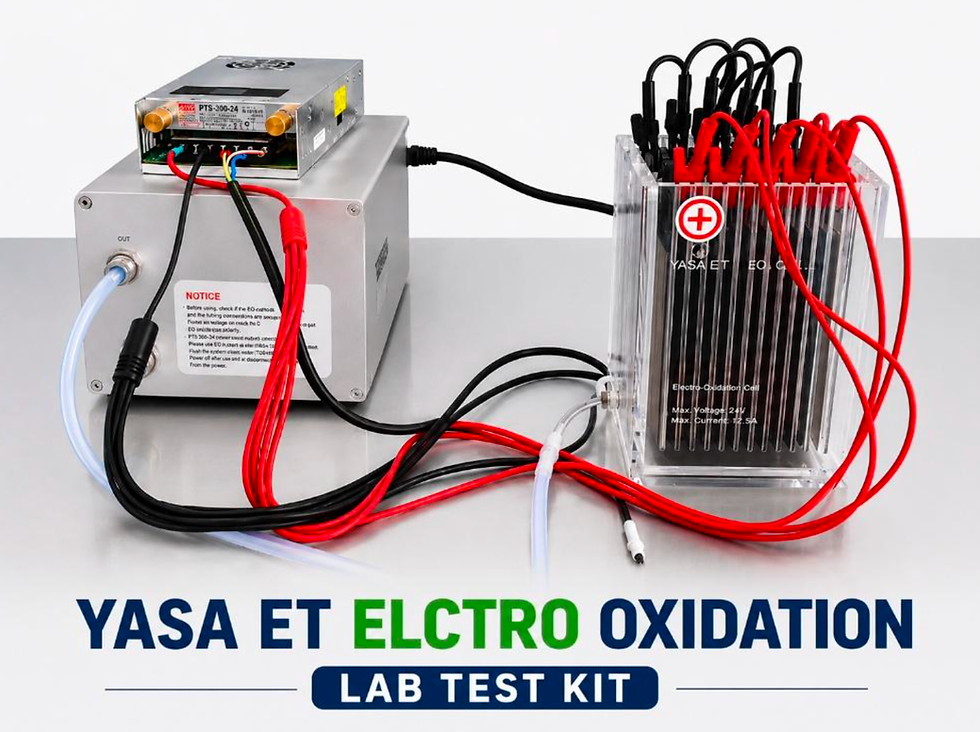
The Test Kit shown in the clip includes:
Transparent acrylic EC/EO reactor
Iron, Aluminum, Titanium, and Ti–Ru–Ir electrodes
Recirculation pump
Flowmeter and wiring set
Adjustable DC Power Supply (0–24 V / 0–30 A)
Plug-and-play kit housing
It is designed for fast testing, easy visualization, and highly repeatable results.
6. System Design & Technical Features
Electrodes
EC uses Iron / Aluminum plates
EO uses Titanium / Ti–Ru–Ir / BDD
Automation
Adjustable current and voltage
Polarity switching capability
Flow control for uniform mixing
Materials
Acrylic reactor for visibility
Corrosion-resistant fittings
Modular design for rapid assembly
7. Example Performance & Test Results (Dye Wastewater)
In the workshop demonstration:
Before Treatment
Deep brown/black dye wastewater
High turbidity
Strong visible color
During EC Reaction
Rapid floc formation
Dye molecules bind to metal hydroxides
Water begins to clarify
During EO Reaction
Remaining color oxidized
COD further reduced
Final water becomes noticeably clearer
Typical results for dye wastewater:
Color removal: 80–99%
TSS removal: >90%
COD reduction: 40–70% depending on dye type
These outcomes validate EC/EO as a strong candidate for textile wastewater pretreatment or polishing.
8. Environmental and Economic Benefits
Reduced chemical usage compared to PAC/PAM
Fewer sludge production due to electrochemical coagulation
Energy-efficient operation at low voltage
Improved water quality for downstream processes (RO / ZLD)
Supports green and circular manufacturing goals
9. FAQs
Q: Can EC and EO be done in the same reactor?
Yes, by switching electrode types (EC = Fe/Al, EO = Ti/BDD).
Q: How long does the test take?
EC typically 10–30 min, EO 10–20 min depending on color intensity.
Q: What dye wastewater types can this handle?
Reactive, disperse, acidic, direct dyes most types respond well.
Q: Can we scale up to industrial size?
Yes, results from this test are used to design full-scale systems.
Q: Does EC/EO reduce sludge?
EC sludge is denser and easier to dewater than chemical coagulation sludge.
10. Ready to Test or Purchase EC/EO Equipment?
YASA ET offers complete solutions for dye wastewater treatment from lab test kits to industrial EC/EO reactors.
You can order:
EC/EO Laboratory Test Kits
Titanium / Ti–Ru–Ir / BDD Electrodes
Industrial EC or EO reactors
Skid-mounted EC–EO or EC–DAF systems
Pilot testing and engineering consultation
Place Your Order or Request a Quote:
📧 Email: info@yasa.ltd
🌐 Website: https://www.yasa.ltd
🛒 Alibaba Store: https://yashahuanjingkeji.m.en.alibaba.com/
📱 Phone / WhatsApp: +86 136 3643 1077



Comments