
EOXCELL – BDD Test Equipment for Advanced Electro-Oxidation
Sep 19, 2025
3 min read
EOXCELL INTRODUCTION

In the field of wastewater treatment, Electro-Oxidation (EO) is emerging as a next-generation technology. It is capable of removing recalcitrant organics such as dyes, pharmaceuticals, PFAS, and toxic compounds that conventional biological processes fail to degrade [3].
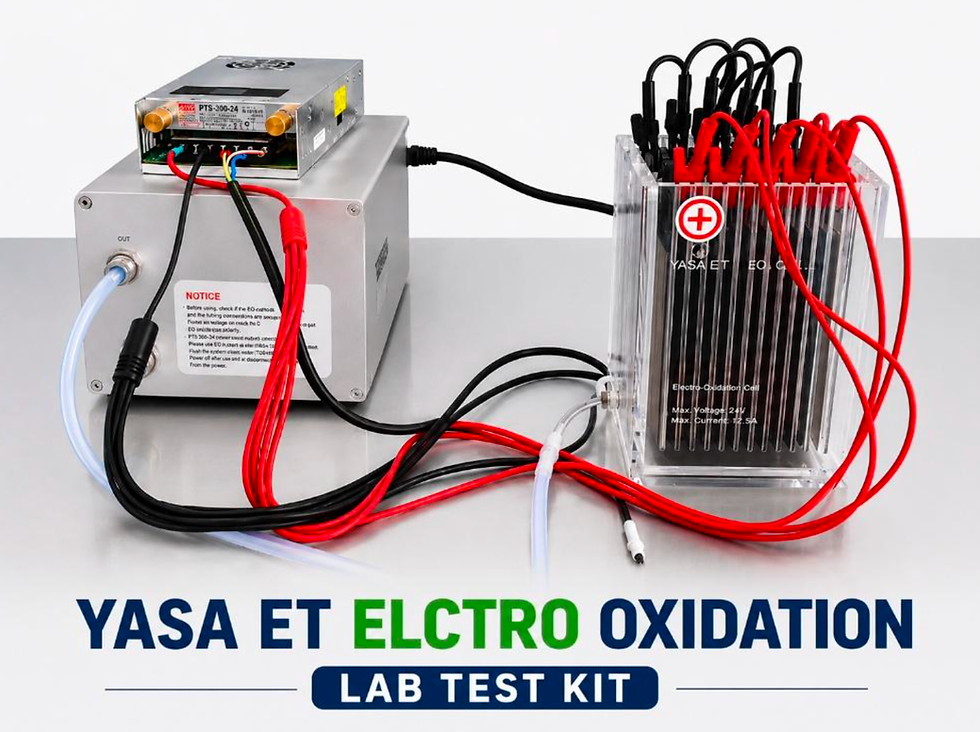
EOXCELL®, developed by YASA ET, is a laboratory-scale Electro-Oxidation Test Cell equipped with Boron-Doped Diamond (BDD) electrodes – widely considered the “gold standard” material in electrochemical oxidation because:
Wide electrochemical window → continuous generation of hydroxyl radicals (•OH)
High durability → 3–5 years lifespan, compared with 6–12 months for Fe/Al electrodes
Corrosion resistance → suitable for saline and high-TDS wastewaters
Scalability → lab results can be directly used for industrial system design
EOXCELL is not just a testing device, but a bridge from laboratory research to full-scale industrial application.
HOW TO USE EOXCELL
Basic operation steps:
Install the test cell – connect EOXCELL to S-EC/EO Test Kits (1A, 5A, 10A)
Select electrodes – BDD cathode with Ti/Ru-Ir or Titanium anode [3]
Set operating conditions – current density between 10–50 A/m² depending on COD/BOD targets [5]
Run the system – fill with sample wastewater, start the recirculation pump, apply voltage
Collect samples – measure COD, BOD, TOC, or specific pollutants after treatment
Operating Modes
Batch Mode – recommended for preliminary tests and contact time evaluation
Continuous Mode – suitable for scale-up studies to simulate industrial operation
📹 Video Demonstrations
CUSTOMIZED BDD PLATES SERVICE
In addition to EOXCELL, YASA ET provides customized BDD electrode fabrication for specific applications.
📌 Standard Options
BDD (10 µm coating) → 296 USD/plate
BDD (20 µm coating) → 498 USD/plate
Substrates available: Titanium or Niobium
📌 Customization Options
Fabrication according to client drawings (size, thickness, shape)
Choice of substrate:
Silicon-based BDD → cost-effective but less resistant to fluoride
Niobium-based BDD → highly resistant to fluoride and aggressive media, longer lifespan [3]
Single or double-sided coating
Customized plates allow researchers to simulate real operating conditions and generate more accurate scale-up data.
WHY BDD IS SUPERIOR
BDD electrodes outperform conventional electrode materials in several aspects:
Wide potential window – hydroxyl radicals (•OH) with oxidation potential of 2.8 V [3]
Durability & Stability – 3–5 years lifespan vs. ~2 years for Ti/Ru-Ir, ~6 months for Fe/Al
Low passivation risk – reduces downtime for cleaning and maintenance [3]
Energy efficiency – pulse current mode reduces energy consumption by 15–25% [5]
Versatility – effective for wastewater treatment, disinfection, and environmental sensing [4]
MARKET TRENDS & INSIGHTS
According to MarketsandMarkets (2025), the global Electro-Oxidation market is expected to grow from USD 1.6 billion in 2025 to USD 2.1 billion by 2030, with a CAGR of ~6% [1].
Key Drivers:
Regulations – EU and US are tightening standards for PFAS and micropollutants [6]
Zero Liquid Discharge (ZLD) – industries in Asia and the Middle East are adopting EO/BDD to meet ZLD mandates [1]
R&D Expansion – universities and research labs are increasingly investing in BDD electrochemistry [3]
CASE STUDY
Refinery Wastewater – Pilot Scale (2025)
Achieved 99.9% phenol removal in 20 minutes at 10 V
COD and BOD reduced by ~50%
Energy consumption: 0.25–0.45 kWh/m³ [2]
Hospital Pharmaceutical Wastewater
BDD electrodes successfully degraded antibiotics and pharmaceuticals that conventional biological treatment failed to remove, without forming toxic by-products [4].
SCIENTIFIC ADVANCES
BDD Film Enhancement – 2025 research shows that nanodiamond seeding improves crystal density, lowers resistivity, and increases electrode lifespan [5].
Environmental Sensors – BDD electrodes are used in toxin and pathogen detection due to low adsorption and high selectivity [4].
PFAS Elimination – WSP announced successful on-site PFAS destruction using EO/BDD in 2025 [6].
CONCLUSION
EOXCELL is more than just a test kit – it is a comprehensive research platform for studying electro-oxidation with BDD electrodes. It enables researchers and industries to:
Test pollutant removal under real wastewater conditions
Evaluate energy consumption and optimize parameters
Generate reliable data for scaling up to full industrial systems
👉 For inquiries about EOXCELL or Customized BDD Plates contact us: info@yasa.ltd



Comments