
Electrochemical Water Treatment Technology
Updated: Apr 10
Electrochemical water treatment technology has become a key solution in the field of water treatment due to its characteristics of no or low chemical dosing, strong oxidation ability, simple operation, easy automation, and resource recovery capability. It is widely used in treating industrial refractory wastewater, circulating water systems, and upgrading water quality standards, making it an important development direction in the water treatment industry.
This article comprehensively explains electrochemical water treatment technology and its supporting equipment from aspects such as core principles, mainstream technology classifications, equipment composition and key parameters,application scenarios, and technical advantages, providing professional reference for industry practitioners.
1. Core Principles of Electrochemical Water Treatment
1. Direct effects
Pollutants undergo direct oxidation or reduction on the electrode surface:
· Organic compounds are oxidized at the anode into CO₂ and H₂O
· Heavy metal ions are reduced at the cathode into elemental metals and deposited.
2. Indirect effects
Under the electric field, water molecules and ions (H₂O, O₂, Cl⁻, etc.) generate highly reactive species such as:
Hydroxyl radicals (•OH)
Active chlorine (ClO⁻)
Hydrogen peroxide (H₂O₂)
Ozone (O₃)
Metal ions (Fe²⁺, Al³⁺) for coagulation
These species drive:
Degradation
Flocculation
Flotation
Disinfection

2. Main Electrochemical Water Treatment Technologies
(1) Electrocoagulation / Electroflotation (EC/EF)
Principle
Anode (Fe/Al) dissolves to produce Fe²⁺/Fe³⁺ or Al³⁺
These form hydroxide flocs (Fe(OH)₃, Al(OH)₃) that adsorb pollutants
Cathode produces hydrogen gas (H₂)
Electroflotation uses gas bubbles (H₂, O₂) to float the flocs to the surface for separation.
Key parameters
Current density: 5–50 mA/cm²
Electrode spacing: 10–50 mm
Reaction time: 10–60 min
Voltage: 3–20 V
Performance
Suspended solids removal: ≥90%
Oil removal: ≥95%
Heavy metals removal: ≥98%
COD reduction: 20%–40%
Applications
Industrial wastewater pretreatment (electroplating, metallurgy, food, textile)
Oil-containing wastewater
Emergency heavy metal removal
(2) Electro-catalytic Oxidation (EO)
Principle
Uses insoluble high-activity anodes to generate strong oxidants such as:
Hydroxyl radicals (•OH, oxidation potential 2.80 V)
Ozone and other radicals
These oxidize refractory organics into CO₂ and H₂O through:
Chain breaking
Ring opening
Mineralization
Ammonia nitrogen can also be oxidized to N₂.
Key parameters
Current density: 10–100 mA/cm²
Anode materials: Ru-Ir coated Ti, Sn-Sb, BDD, PbO₂
pH: 3–9
Temperature: 20–40°C
Performance
COD removal: 60%–90%
Ammonia removal: ≥99%
Improves biodegradability (B/C ratio <0.2 → >0.3)
Applications
Chemical, pharmaceutical, pesticide wastewater
High-salinity refractory wastewater
Industrial upgrade to stricter discharge standards
(3) Electro-Fenton (EF)
Principle
Cathode reduces O₂ → H₂O₂
Fe²⁺ reacts with H₂O₂:Fe²⁺ + H₂O₂ → Fe³⁺ + •OH + OH⁻
Produces hydroxyl radicals for oxidation. Fe³⁺ is recycled back to Fe²⁺.
Types
Traditional electro-Fenton
Fluidized bed electro-Fenton
Photo-assisted electro-Fenton
Key parameters
pH: 2–4
Current density: 5–30 mA/cm²
Fe²⁺ dosage: 0.1–1.0 mmol/L
Performance
COD removal: 80%–95%
Dye/phenol/pesticide removal: ≥99%
Applications
Dyeing, chemical, pharmaceutical wastewater
Landfill leachate
Emergency wastewater treatment
(4) Electrodialysis (ED) / Capacitive Deionization (CDI)
Electrodialysis (ED)
Principle
Ion exchange membranes separate cations and anions under DC electric field, achieving desalination.
Applications
High-salinity industrial wastewater
Reuse water desalination
Seawater pretreatment
Brine concentration recovery
Capacitive Deionization (CDI)
Principle
Ions are adsorbed onto carbon electrodes under electric field and released during regeneration.
Applications
Low-salinity water treatment
Drinking water purification
Electroplating rinse water reuse
(5) Electrochemical Disinfection & Anti-scaling
Principle
Active chlorine and radicals destroy cell membranes and DNA
Electric fields inhibit microbial reproduction
Anti-scaling:
Cathode increases pH → Ca²⁺/Mg²⁺ precipitation
Prevents scale formation on pipes and equipment
Applications
Cooling water systems
Air conditioning systems
Water supply pipelines
RO pretreatment

3. Equipment Composition
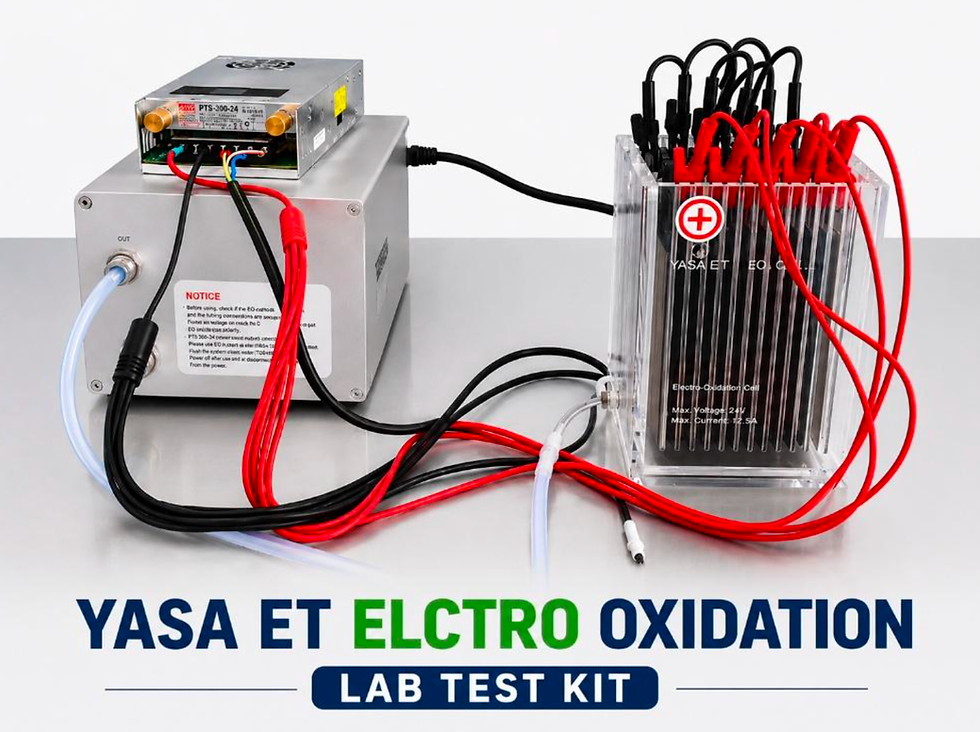
(1) Core reactor (electrolysis cell)
Types:
Plate-and-frame (most common)
Fluidized bed
Rotating electrode
3D electrode systems
Electrodes:
Soluble: Fe, Al (coagulation)
Insoluble: Ti-based coatings, BDD, PbO₂
(2) Auxiliary systems
DC power supply (switch-mode is mainstream, efficiency ≥90%)
Water & gas distribution system
Solid-liquid separation (sedimentation, flotation, filtration)
Acid cleaning system for electrode maintenance
(3) Automation system
Monitors:
pH, ORP, conductivity
COD, ammonia
Voltage, current, flow
Functions:
Automatic parameter adjustment
Fault alarms
Remote monitoring

4. Advantages & Development Trends
Advantages
Environmentally friendly (low chemical use)
High efficiency for refractory pollutants
Easy operation and automation
Strong adaptability to different wastewater types
Development trends
Advanced electrode materials (BDD, carbon-based)
Hybrid processes (electrochemical + biological + membrane)
Smart automation (IoT, AI optimization)
Resource recovery (metals, salts, energy)
5. Summary
Electrochemical water treatment is an advanced green technology that is gradually replacing traditional physical and chemical processes. With continuous improvements in materials, equipment, and smart control systems, it will play an increasingly important role in industrial wastewater treatment and water resource recovery.



Comments